Use AI to build your practice · from a psychologist, not an agency

Most therapist websites don't have a traffic problem. They have a recognition gap.

People arrive, read, and leave. Not because they dislike you, but because they couldn't tell, fast enough, that you're for them. See what a new client (and an AI) can and can't tell about your practice in 60 seconds.

  • Know in 60 seconds what a new client (and an AI) can't tell about your practice
  • Walk away with the one thing to fix tonight
  • Built with your license in mind: no client data anywhere in the process. The free Score uses no AI; the paid prompts draft from facts you provide, and you verify every claim before it goes live.
Dr. Nicholas Gehle, Psy.D. · licensed clinical psychologist, building Strua in public
Free: your Recognition Score + "The Therapist's First Hour With AI." No charge.
Free · no email needed · a count of what we found, not a grade

The people who need you can't tell you're for them.

Get your free Recognition Score — a psychologist's clarity check, not a website audit. Paste your homepage and see what a first-time visitor (and an AI) can and can't tell about your practice in seconds. If you're stuck on where to start, it hands you the one thing to fix tonight. No AI inside it — every finding traces to a transparent rule.

Your Recognition Score
What do you want more of? (optional)

No website yet? Paste your Psychology Today link. We’ll show you what we can check on a directory profile, and what we can’t.

Free, instant, and the score is yours either way — no email wall.

What is a recognition gap?

A recognition gap occurs when a potential therapy client cannot quickly tell from a therapist’s website who the therapist helps, what problems they treat, or whether they are the right fit. When this information is unclear, qualified visitors often leave before contacting the practice.

In the second edition of our Therapist Recognition Index (September 2026), we checked 133 therapist practice pages. 54 of 83 local practices we could assess put their city or state in the page title, site header or main headings, and only 5 of 132 named a clinician with a role or credential in their structured data (the information a site publishes for search engines and AI assistants to read).

What one fix looks like

One rewrite — from invisible to “that's me.”

After: the same practice's homepage rewritten. The first screen says who it helps, what with, where, and offers a free 15-minute consult. Before: the 2015 Gehle Psychological Solutions homepage. The first screen is a logo, a menu and a waterfall photo, then a Welcome paragraph. Before · 2015 · 4 of 11 found After · rewritten · 11 of 11 found

Drag to compare. Dr. Gehle’s 2015 practice homepage, and the same practice rewritten with the Get Found steps. Same logo, same photo, new words. Both pages are recreations for this demo; the practice isn’t taking clients.

And a real one

Same fix, on a real homepage.

A psychotherapist in London read the one-line fix above and rebuilt her front door around it in two weeks.

The website has completely transformed over the last couple of weeks, and I'm really pleased with where it has ended up.
Nayo Butler-Puttock, psychotherapist, London
nayopsychotherapy.com

Her words, shared with her permission.

How it works

Three steps — the first two are free.

1Free

See the gap

Your Recognition Score. See exactly why the right clients can't tell you're for them.

2Free

Learn the skill

The Therapist's First Hour With AI. Your first hour using AI to fix it — no tech skills, and a compliance gate before anything goes live.

3$49

Fix it fully

Practice Builder: Get Found. Complete on its own, and the first step on the Builder's Path if you ever want more. The full build system: guide, editable templates, the scan-driven Core Build, examples, paste points, and a handoff brief for your AI or web person.

The painful truth
Your homepage says:
“Welcome.”
Everyone else's does too.
Your Psychology Today profile starts with:
“I am a Licensed…”
So do the 40 profiles around yours.
You ask AI: “Find a therapist near me for anxiety.”
It never mentions you.
It can only surface what a page makes clear.
Most therapists assume they need more traffic.Most actually need more clarity.

The right client visited your website.

They left in seconds.

Not because they disagreed with you.

Because they couldn't tell, fast enough, that you were for them.

What a page doesn't make clear, an AI can't pass along — and neither can a scared person at 11pm.

The patterns we see again and again

These aren't random mistakes. Whether you treat anxiety, trauma, or couples, it's the same six, on almost every site.

01
The “Welcome” headlineGreets visitors instead of naming who you help.
02
“I help everyone”Couples, teens, trauma, grief, ADHD… so no one feels chosen.
03
Credential-first profileOpens with “I am a Licensed…” — like the 40 profiles around it.
04
The buried next stepFive ways to contact you, so visitors take none of them.
05
The jargon wall“Multimodal therapeutic frameworks” — words no anxious person types.
06
No city, anywhereSo neither Google nor a local client can place you.

Each one is a symptom of the same root cause:
a highly-trained clinician communicating like a clinician — instead of like a human.

You were trained to hold nuance and avoid overgeneralizing. Great in the room. Quietly invisible online. No marketing agency can name that — because they've never sat in your chair.

Your six-pattern language made [the fixes] much faster to spot than going on instinct alone. I really like the way the Recognition Score separates clarity from design. They're different things, but both matter.
Basirat Aderinwale, Web Designer

Her words, shared with her permission.

Why I built this

A psychologist who builds — and kept seeing the same thing.

I'm a licensed clinical psychologist with an MBA, and I build real software — Strua, a mental-health app — in public.

Spend time around therapist websites and the same few problems show up on almost all of them: a “Welcome” headline, too much jargon, no clear niche, a weak next step. Brilliant clinicians, quietly invisible online.

It isn't really a marketing problem. It's that we were trained to communicate like clinicians — not like the person in pain who's deciding, in a few seconds, whether we're for them.

So I built this: not a done-for-you service, but a way to use AI — safely, inside our ethics — to fix it yourself. Start with the website. The same skill builds everything else.

— Dr. Nicholas Gehle, Psy.D.
The visibility stack

Clients move through five layers. Most therapists optimize one.

A client looking for help anxious · skimming · 11pm
Psychology Today the opening line
Google & Maps local search
AI search can it understand you?
Your website do they recognize themselves?
A consult request

Practice Builder: Get Found teaches you to use AI to fix every layer — yourself, without hiring an agency.

Step 2 · Learn the skill · free

The Therapist's First Hour With AI

Field Guide #1 — an 18-page designed guide: five experiments, your reusable Practice Brief, a five-point pre-publish compliance gate, and a prompt bank you’ll keep. No tech skills, no client data needed, and a five-point compliance gate before you publish.

5experiments
1hour
$0to start
Send me the First Hour
Just your email. No spam — used only to send the guide and the Builder's Letter, and you can unsubscribe anytime.
You'll also get the Builder's Letter — an occasional note on using AI to build the practice your training never taught you to build. Unsubscribe anytime.
Practice Builder: Get Found · $49 · Complete on its own

Your first real project: use AI to make your practice easy to find.

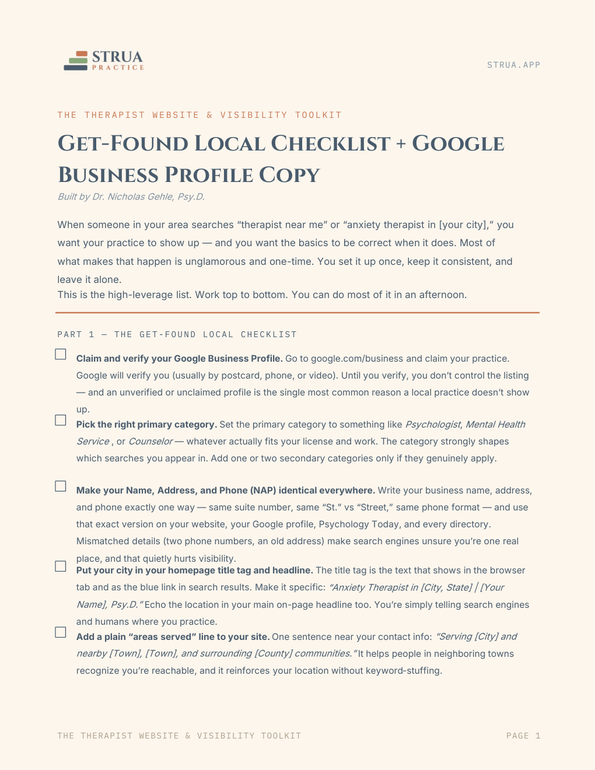
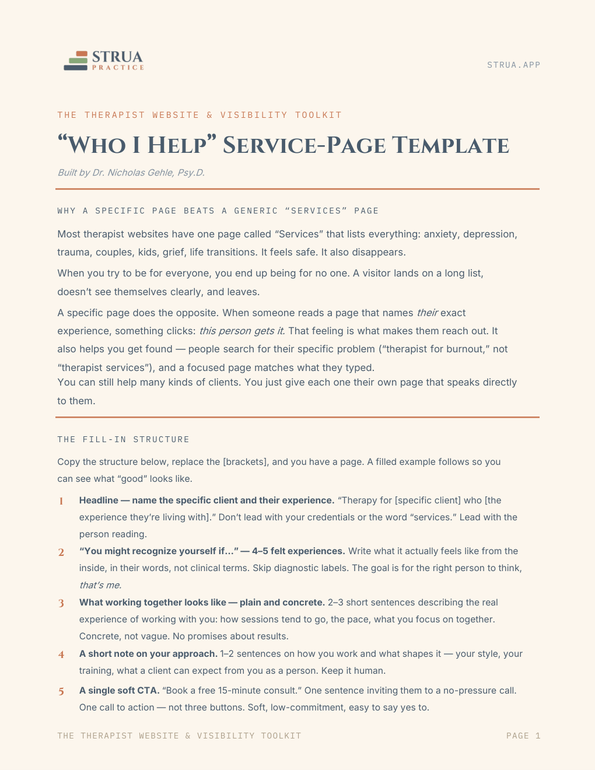
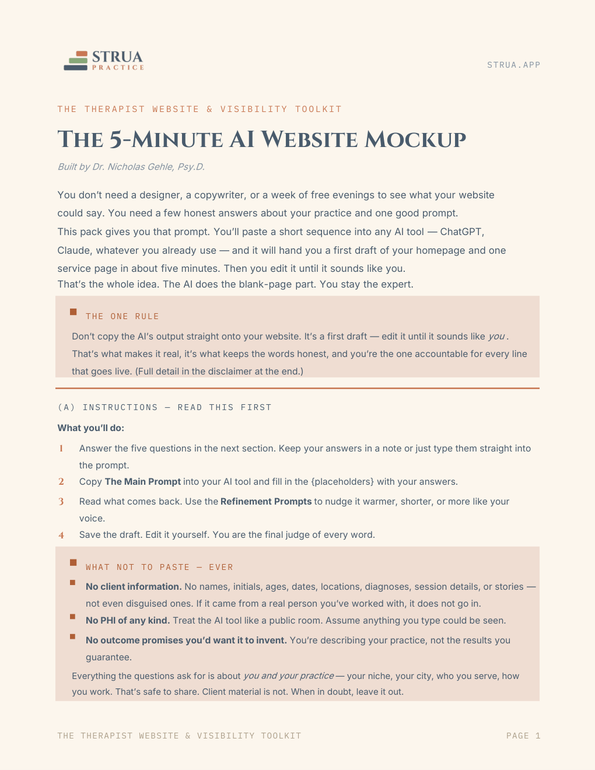
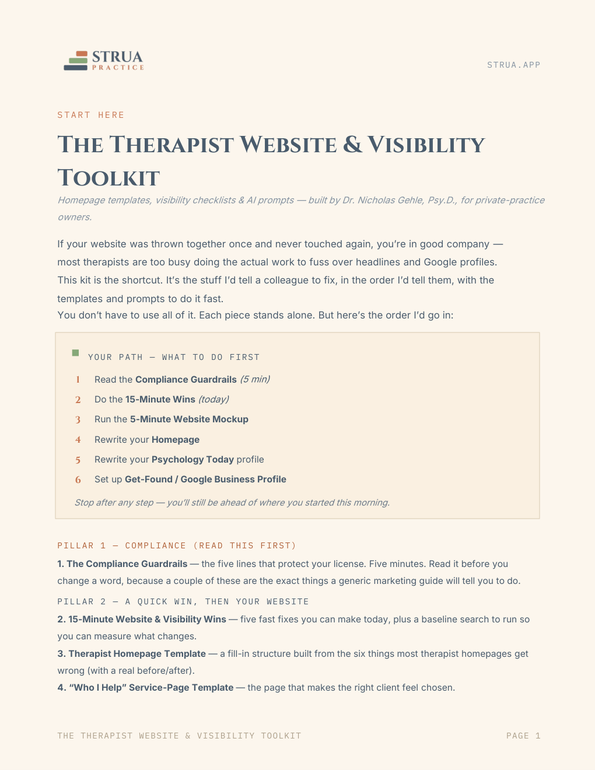
A scan-driven build kit: the 31-page Get Found Build Guide, eight template docs with editable DOCX copies, a measurement sheet, fill-in schema files, and five support docs that show you what to do first, what “done” means, and where each piece gets pasted — safely, inside your ethics.

Every step is concrete and in order, written for how people find therapists now: Google, Psychology Today, and AI search. Updates included for 12 months.

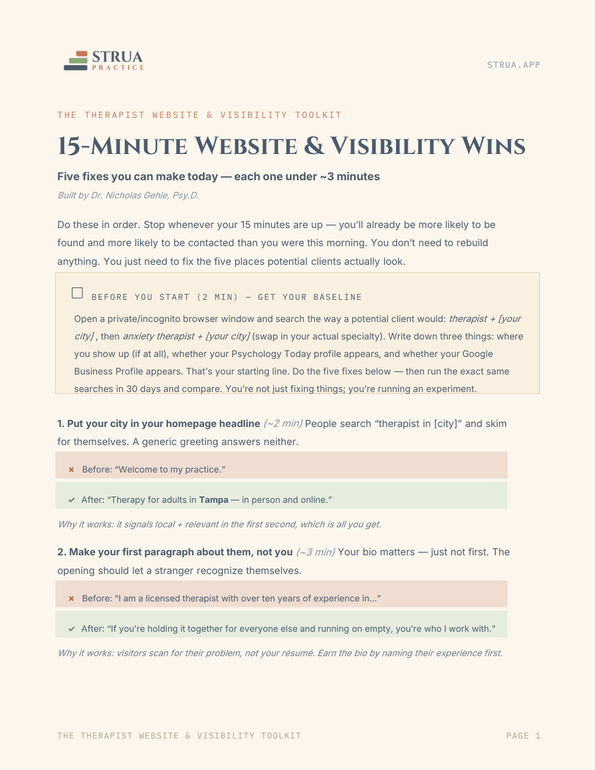
Start Here Compliance Guardrails Homepage Template Psychology Today Rewrite 15-Minute Wins Get-Found Checklist Service Page Template AI Website Mockup

The Core Build

“Your scan said X → start at step Y.” The build order with done-when criteria for every step — your score becomes the plan.

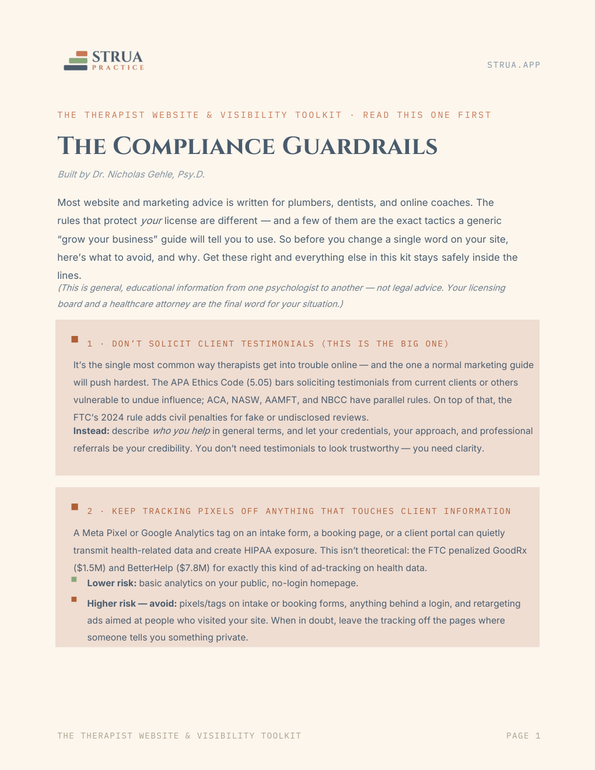
Compliance Guardrails

Don't accidentally create ethical or legal risk. The five marketing landmines — and how to stay inside your board's rules.

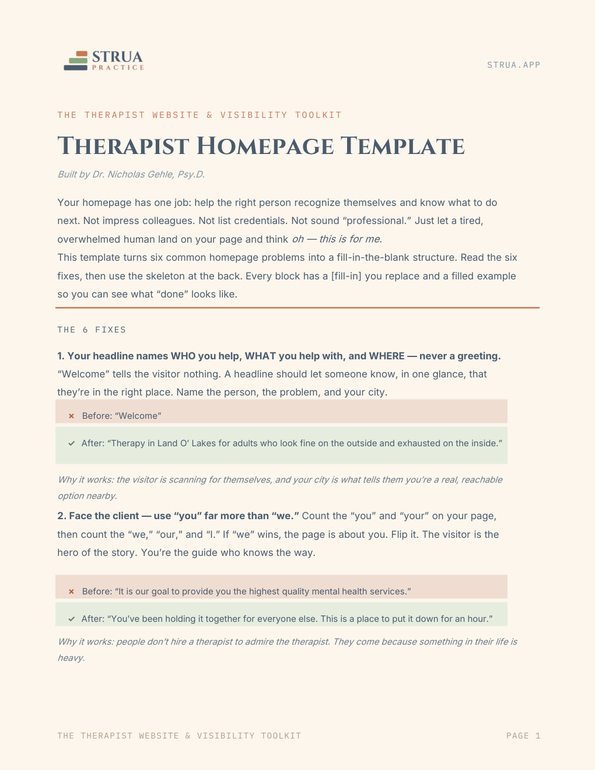
Homepage Template

Fix the six mistakes most therapist homepages make — a fill-in structure with a real before/after.

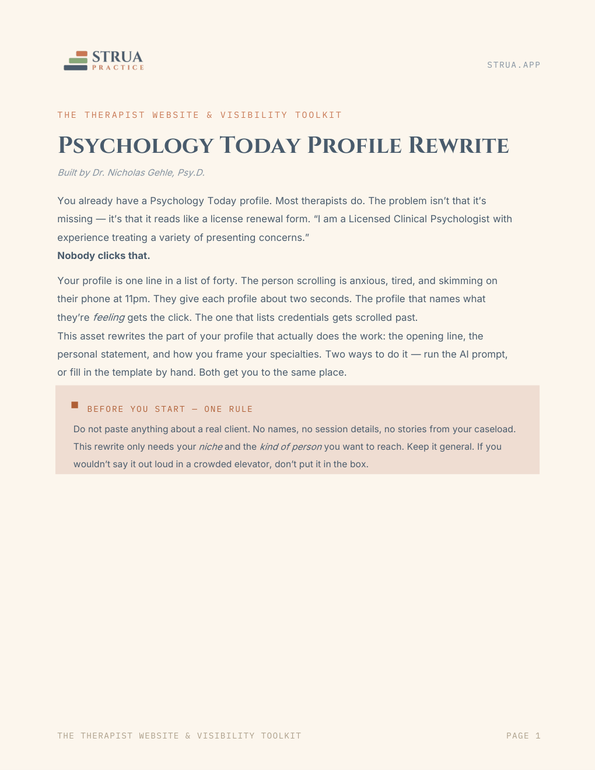
Psychology Today Rewrite

The one sentence that decides whether anyone clicks — and how to write yours.

5-Minute AI Website Mockup

Generate a complete homepage draft in minutes — with the ethics guardrails built into the prompt itself.

Get-Found Local Checklist

Google Business Profile, local visibility, and the AI signals that decide whether you show up nearby.

“Who I Help” Service Page

The page that makes the one right client feel chosen — instead of one more generic services list.

Worked Example + Example Bank

Fictional composite builds across five practice models — solo, hybrid, child and teen, group, and online-only — so you’re never adapting blind.

Paste Points, Glossary + Editable Files

Where every piece goes in Squarespace, Wix, WordPress, and SimplePractice — plus a plain-words glossary, editable DOCX templates, a measurement sheet, and fill-in schema files.

The $49 decision

Three ways to handle this.

Hire an agency
$2k–$10k+
Months of back-and-forth — and they may not understand therapist ethics.
Ignore it
$0
Nothing changes. The right clients keep scrolling past you.
Use Practice Builder
$49
Fix the highest-impact problems yourself, in order — editable templates, paste-ready copy, a re-scan loop, and a brief you can hand to your AI or web person.
Get Practice Builder: Get Found

Some services now charge $148 a month to check whether AI describes your practice correctly. The Get Found kit is $49, once. You learn to do it yourself, and you keep it.

Licensed for one practice brand — solo or group, office-based or online-only. Includes 12-month updates and a 14-day money-back guarantee: download it, try it, and if it doesn't fit your practice, email [email protected] within 14 days for a full refund. All examples are fictional composites. Designers, developers, and consultants who want to use the materials across client projects can tell us what you need.

Why listen to me

Most people teaching this are marketers. I'm the psychologist who ships.

✓ Licensed clinical psychologist (Psy.D.)
✓ MBA
✓ Built & ran a private practice
✓ Built Strua, a real mental-health app
✓ Uses AI daily to build
✓ Teaches the ethics + compliance, not just tactics
Honest answers

The questions therapists ask first.

Is this just marketing fluff dressed up for therapists?

No. It's guided AI prompts and a clear order of operations, from a licensed psychologist who knows what you can and can't ethically do online. Compliance is the first piece in the kit, not an afterthought: every template was written with the common licensing-board and FTC landmines in mind, and your board's rules always come first.

What exactly do I get?

The 31-page Get Found Build Guide; eight template docs (compliance guardrails, 15-minute wins, homepage, Who-I-Help, Psychology Today rewrite, local checklist, the AI mockup prompt pack, and a start-here) with editable DOCX copies; five support docs — The Core Build, a fully worked example, an example bank across five practice models, platform paste points, and a plain-words glossary — plus a measurement sheet, fill-in schema files, and a handoff brief for your AI or web person. Licensed for one practice, 12-month updates, 14-day money-back guarantee, even after you download.

I'm not techy. Will I actually be able to use it?

Yes. Most of the wins are editing words you already have — your homepage's first line, your Psychology Today opening sentence. No code, no rebuild, no designer. The AI pieces hand you a first draft; you edit it until it sounds like you.

What if someone else manages my website?

Even better. The kit gives you the Core Build order, platform paste points, editable DOCX files, schema files, and a handoff brief — so your web person, assistant, or your own AI can execute the next step without guessing. Most therapists have never been able to say precisely what they want fixed. Now you can.

I know it needs work but I have no idea where to start.

That's the most common place to be — and exactly what this is for. It's scan-driven: your free score names the gap, the Core Build turns it into a starting step, and every step has done-when criteria so you know when to re-scan. You're buying direction and confidence, not a pile of homework.

What about HIPAA and my ethics code?

That's the part most marketing advice gets dangerously wrong — quoting happy clients, tracking pixels, outcome promises. The toolkit's opening section walks the five landmines and how to stay inside APA/ACA rules and FTC guidance. It's educational guidance, not legal advice — your board always wins — but it's built by someone who lives inside those rules.

Do I need to be good at AI?

No — that's the point. This teaches you to use AI from zero, with the exact prompts, safely and inside your ethics. AI does the heavy lifting on the blank page; you stay the expert on every word that goes live. Learning to use AI well IS the real skill you're building here — starting with your website.

Will this help my actual clients, or just my caseload?

Both. A clearer website helps the right person recognize themselves and reach out — which means the people who need your particular work are the ones who find you. Being easier to understand is a service to them, too.

This is really about one thing: becoming easier to understand.

It starts with your website — but the same skill carries into your Psychology Today profile, your Google listing, AI search, your handouts, your talks. Start where it's easiest. This weekend. For $49.

Get Practice Builder: Get Found

Licensed for one practice brand — solo or group, office-based or online-only. Includes 12-month updates and a 14-day money-back guarantee: download it, try it, and if it doesn't fit your practice, email [email protected] within 14 days for a full refund. All examples are fictional composites. Designers, developers, and consultants who want to use the materials across client projects can tell us what you need.